Is SEO Dead in 2026? What the Data Actually Says
I am late to the search party. People far better than me spent two decades taming Google into a machine that produced leads on demand, and I arrived just as everyone started writing its obituary.
In the past week alone, half a dozen marketers have told me some version of “search is dead, SEO is dead.” I nodded politely but internally had a doubt about the assertion.
To be fair, their complaints are real. AI slop has flooded the web. AI Overviews have pushed the ten blue links below the fold. Bot traffic is up, human clicks are down, and dashboard charts that used to go up and to the right; now go downwards for most folks. I agree with almost all of it.
What I disagree with is the conclusion. I am not defending the old playbook; 4,000 generic words and a few internal links stopped being a growth strategy some time ago, and organic clicks are plainly not immune to AI. My claim is narrower:
Search is not disappearing. It is being compressed, abstracted and redistributed. And the discipline of being found is evolving with it.
The evidence for that comes in four steps: is search demand actually shrinking, are clicks shrinking, which clicks are shrinking, and what is growing in their place. Then, what it means industry by industry, and what we should be measuring instead.
Part 1: Four things are happening at once, and they are not the same thing
Most “SEO is dead” arguments collapse four separate trends into a single metric. Pulling them apart is most of the work.
| Trend | Direction in 2026 | What it actually measures |
|---|---|---|
| Search demand | Still enormous, still growing | Whether people still ask |
| Traditional organic CTR | Under real pressure | Whether a query becomes a website visit |
| AI-mediated answers | Growing fast | Where the answer gets assembled |
| AI referral traffic | Doubling annually from a small base | A new discovery channel forming |
Track only the second row and everything looks like decline. Track all four and it looks like redistribution.
Part 2: Search demand is not shrinking. It is at an all-time high.
Let’s start with something deliberately boring: money.
If search were dying at the rate LinkedIn suggests, Google’s search business should be showing distress. Instead, Google’s advertising revenue grew from about $79 billion in 2016 to $295 billion in 2025, a 3.7x increase, and it accelerated after ChatGPT launched.
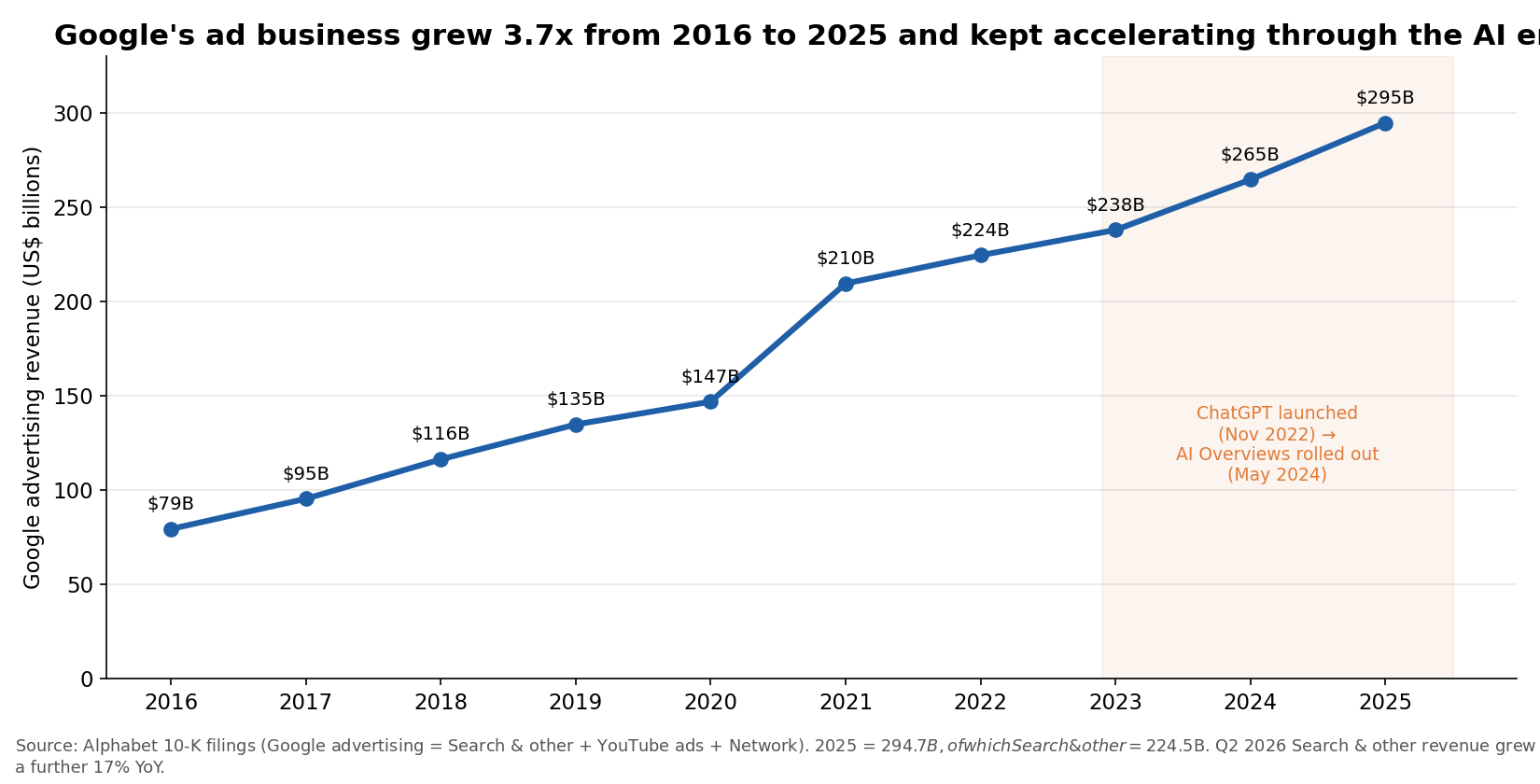
The 2025 annual report shows Google Search & other revenue rose $26.4 billion year on year to $224.5 billion, and Alphabet attributes part of that to “increases in search queries.” Paid clicks on Search grew 6% in 2025. Then in Q2 2026, a full year into the AI Overviews and AI Mode era, Search & other revenue grew another 17% to $63.3 billion, and Sundar Pichai told analysts that search usage hit an all-time high during the World Cup.
Two caveats. Google’s ad revenue is not a proxy for organic traffic; Google can monetise harder even while publishers suffer. And a company has every incentive to describe its core product as healthy. So I would never use this as evidence that “SEO is fine.” I use it as evidence against the far bigger claim that search itself is dying. Those are different arguments.
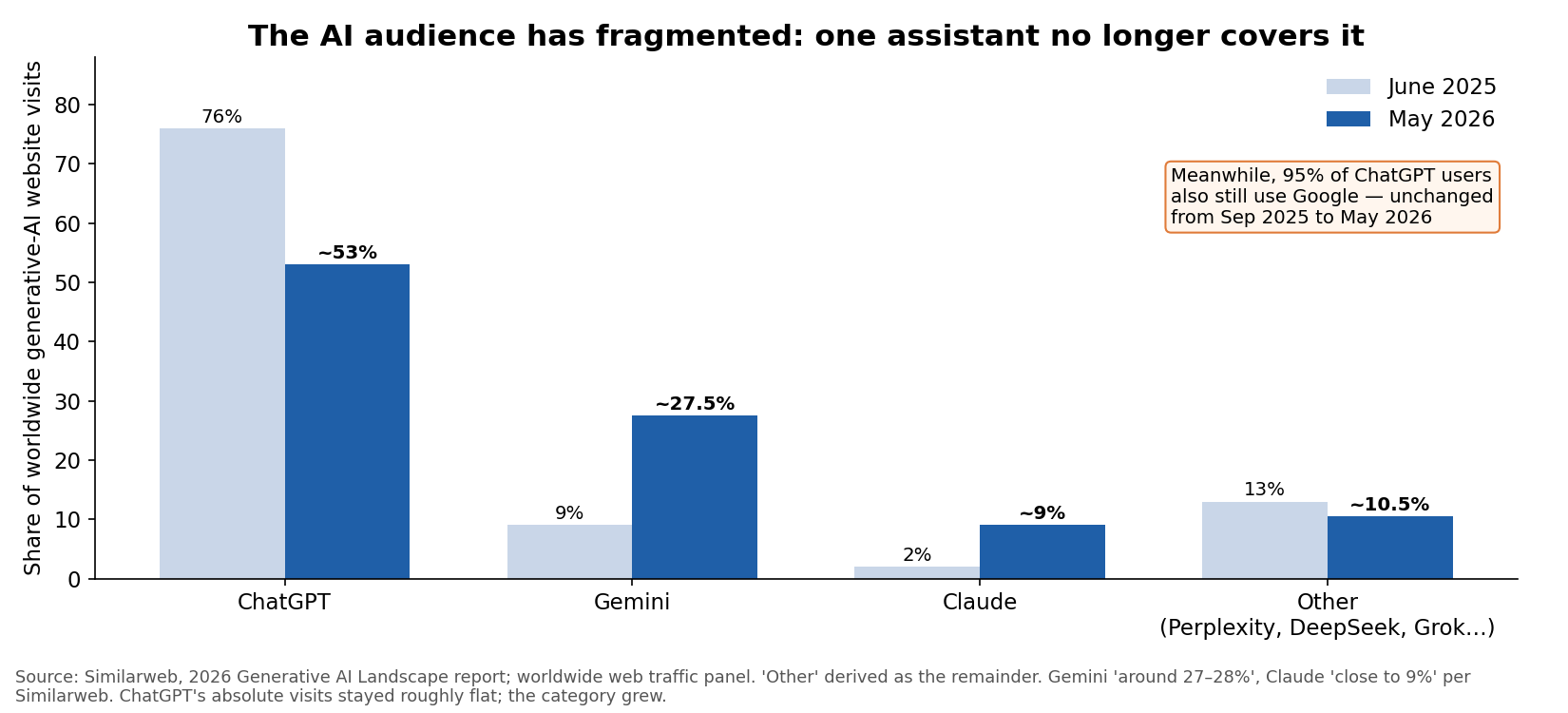
There is a second, independent data point that I find more persuasive than the revenue. Similarweb tracks the overlap between ChatGPT’s user base and Google’s. In September 2025 it was 95%. In May 2026, after hundreds of millions of additional AI visits, it was still 95%. If people were swapping search for AI, that number would be falling. It has not moved.
Add to that the broader picture: Google still handles roughly nine in ten global searches, and generative-AI platforms received 9.5 billion monthly web visits in May 2026 (up 70% year on year) without denting search. People are adding a tool, not replacing one.
Search-engine dominance, however, is not the same as organic-click dominance. Google can remain the place people ask questions while sending fewer clicks to the people who answer them. That is exactly what is happening, and it is why “SEO is dead” feels true to publishers: the click is not the query, and they are measuring the right pain in the wrong layer.
Part 3: But the click really is under pressure
Pew Research Center tracked the actual browsing behaviour of 900 US adults across 68,879 Google searches in March 2025. When a search produced an AI summary, users clicked a traditional result 8% of the time. Without an AI summary, 15%. Links inside the AI summary itself were clicked on 1% of visits. And users were far more likely to end their browsing session entirely after seeing a summary: 26% of the time versus 16%.
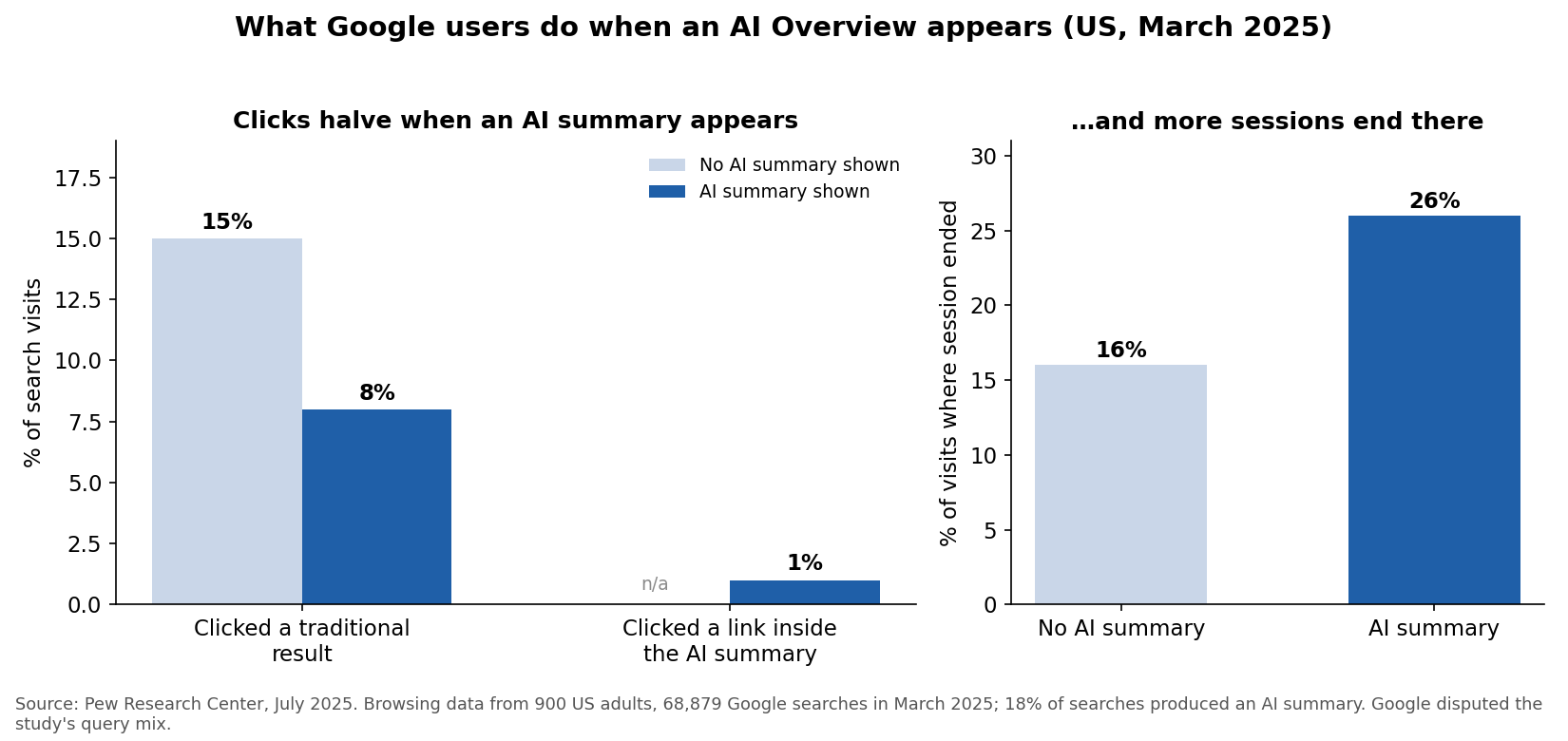
Google disputed Pew’s query mix, and the study predates several product changes, but the direction has been confirmed from every angle since. Ahrefs’ analysis of Search Console data found AI Overviews cut clicks by roughly 58% on affected queries. Similarweb now sees AI Overviews on more than 40% of US searches, up from about a third a year earlier. And Ahrefs’ monthly CTR benchmarks, built from 400,000 sites, put a “good” whole-site organic CTR at just 1–2% in 2026.
This is not a ranking problem. It is an interface change: the search engine can now satisfy the query without the user leaving.
Part 4: Which clicks are dying? Not the ones that matter most.
The conclusion most people draw from Pew is too broad. They see AI summary → fewer clicks and conclude AI → fewer searches → SEO dies. The data supports something narrower: AI summary → fewer clicks on some classes of query.
Pew’s own breakdown makes this concrete. Only 8% of one- or two-word searches produced an AI summary. For searches of ten words or more it was 53%, and for questions beginning with who, what, when or why it was 60%.
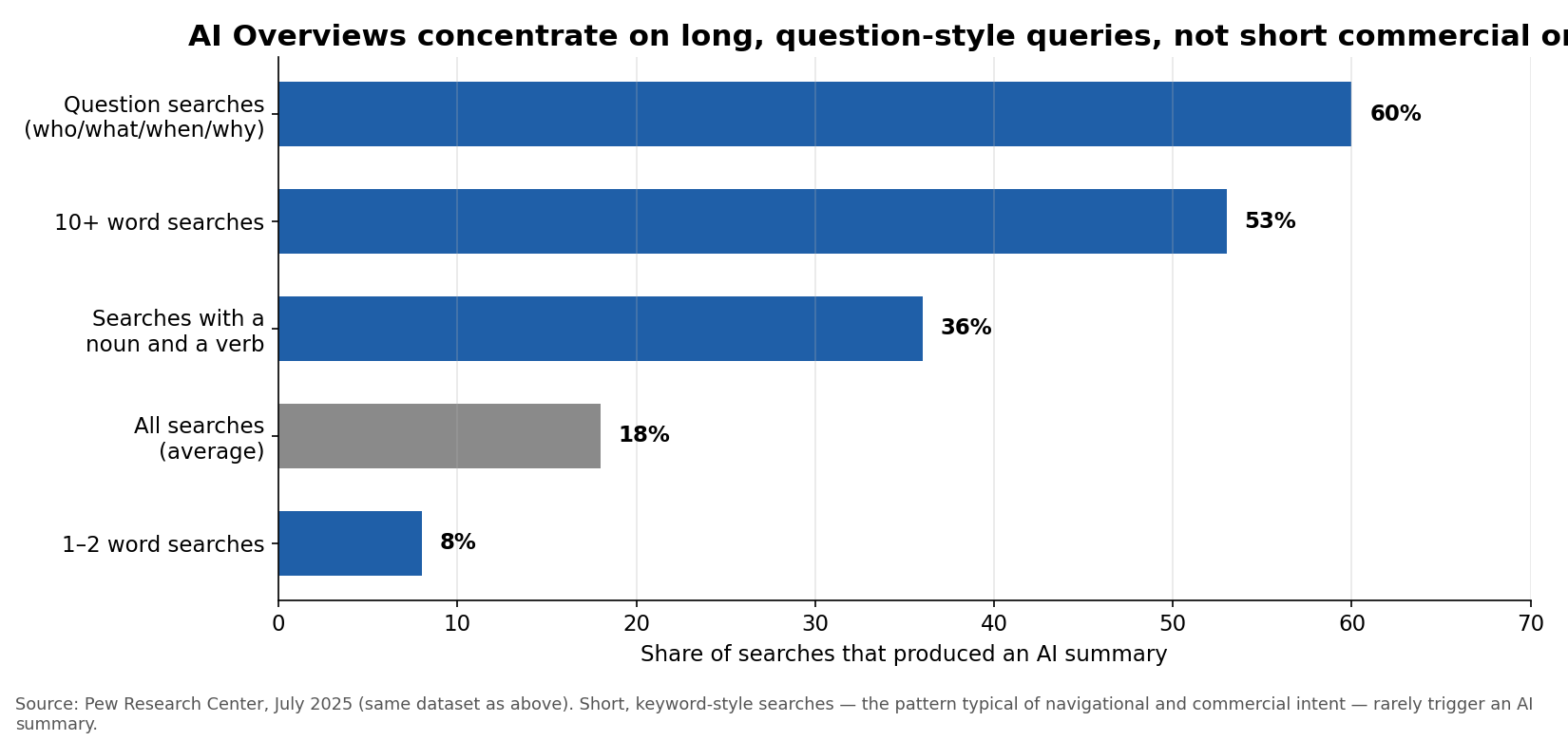
Think about what those buckets contain. Short, keyword-style queries are overwhelmingly navigational and commercial: brand names, product names, “plumber near me,” “HubSpot pricing.” Long, question-style queries are informational: “what is the difference between EBITDA and operating income.” AI is eating the second bucket. It is barely touching the first.
Compare two searches:
“What is the capital of France?”
“Best CRM for a 50-person SaaS company with Salesforce integration”
The first person doesn’t need your website. The second person has commercial intent, constraints, preferences and a budget. They want pricing, reviews, implementation details, and probably a conversation. The economic value of those two clicks was never remotely equal. AI is compressing the cheap one.
Not every query deserved a website in the first place
An enormous amount of web content exists only because Google created an incentive to produce it. “How many calories in a banana.” “How to calculate CAGR.” Thousands of sites wrote near-identical answers, and then generative AI arrived and summarised all of it in three paragraphs. For those queries the user is better off, and we cannot complain that the web is full of low-quality content while also complaining that AI removed the need to visit it. The casualty is not information. It is commodity information.
Part 5: The new channel is real, and it is growing faster than anything else in marketing
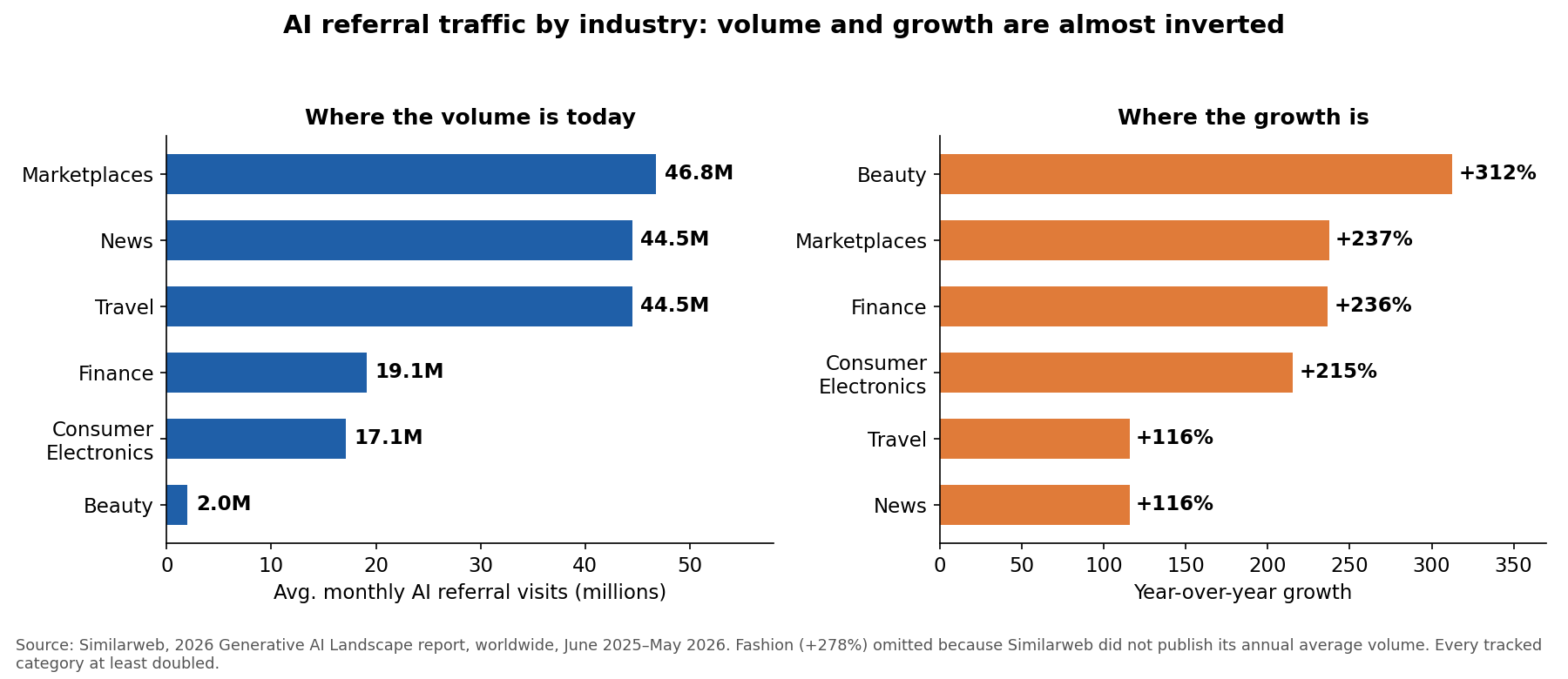
Similarweb’s 2026 Generative AI Landscape report puts worldwide AI referral traffic at 770.7 million visits per month on average between June 2025 and May 2026, up 117% on the year before. Every single industry it tracks at least doubled. And on May 7, 2026, ChatGPT replaced its footnote-style citations with prominent clickable brand names inside answers; referral traffic roughly tripled within days and, crucially, never gave any of it back.
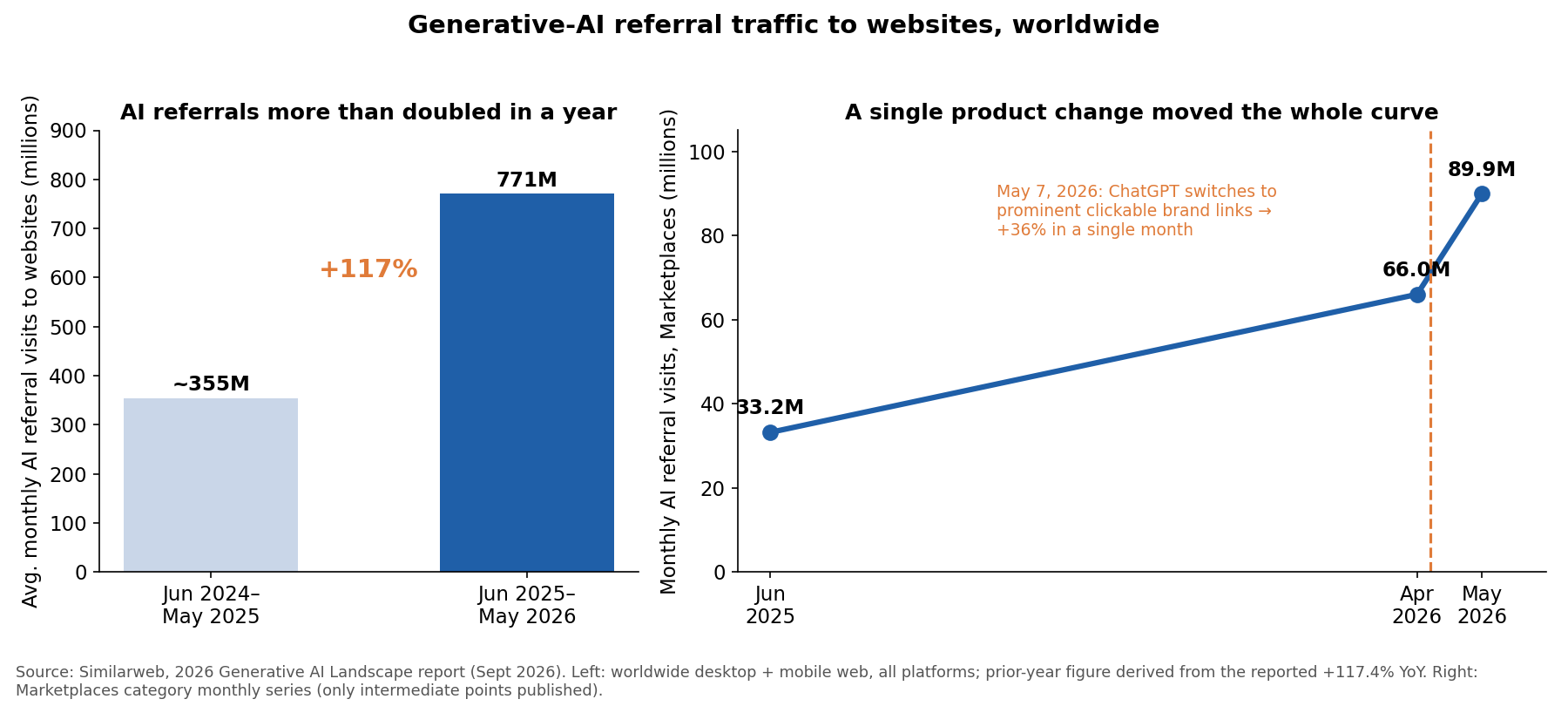
The distribution of that traffic is the more interesting story. Volume today sits where an AI answer must hand off to a website: marketplaces, news and travel. Growth sits where consumers are learning to shop by conversation: beauty, fashion, finance and electronics.
Three things about this channel matter more than its size.
First, it converts. Adobe Digital Insights measured AI-sourced traffic to US retail sites converting 54% better than non-AI sources by May 2026, a reversal from a year earlier when it converted worse. These are not idle browsers.
Second, the referral count is a floor, not a ceiling. About six in ten ChatGPT referrals now land on a homepage rather than a deep page: users arrive having already decided, more like the tail end of an ad impression than a search click. And Similarweb finds that people who see a brand recommended in an AI answer are 2.5x more likely to visit it, mostly via branded search rather than a referral link. Your analytics files that under “organic” or “direct.” AI’s real influence is systematically undercounted.
Third, the audience has fragmented. ChatGPT’s share of generative-AI web traffic fell from 76% to about 53% in a year, not because it shrank but because Gemini (now over a quarter of traffic) and Claude (approaching a tenth) grew faster. A visibility strategy built around one assistant reaches roughly half the market.
From ranking to citation
Google’s model was built on ranking. AI systems introduce a second unit of value, the citation: being one of the sources the answer engine trusts enough to name.
Citations are still uncommon (6.8% of US ChatGPT prompts in May 2026) but that is up from 1.6% eleven months earlier. And they cluster exactly where you would expect: in categories where the user needs to check, compare or buy something specific.
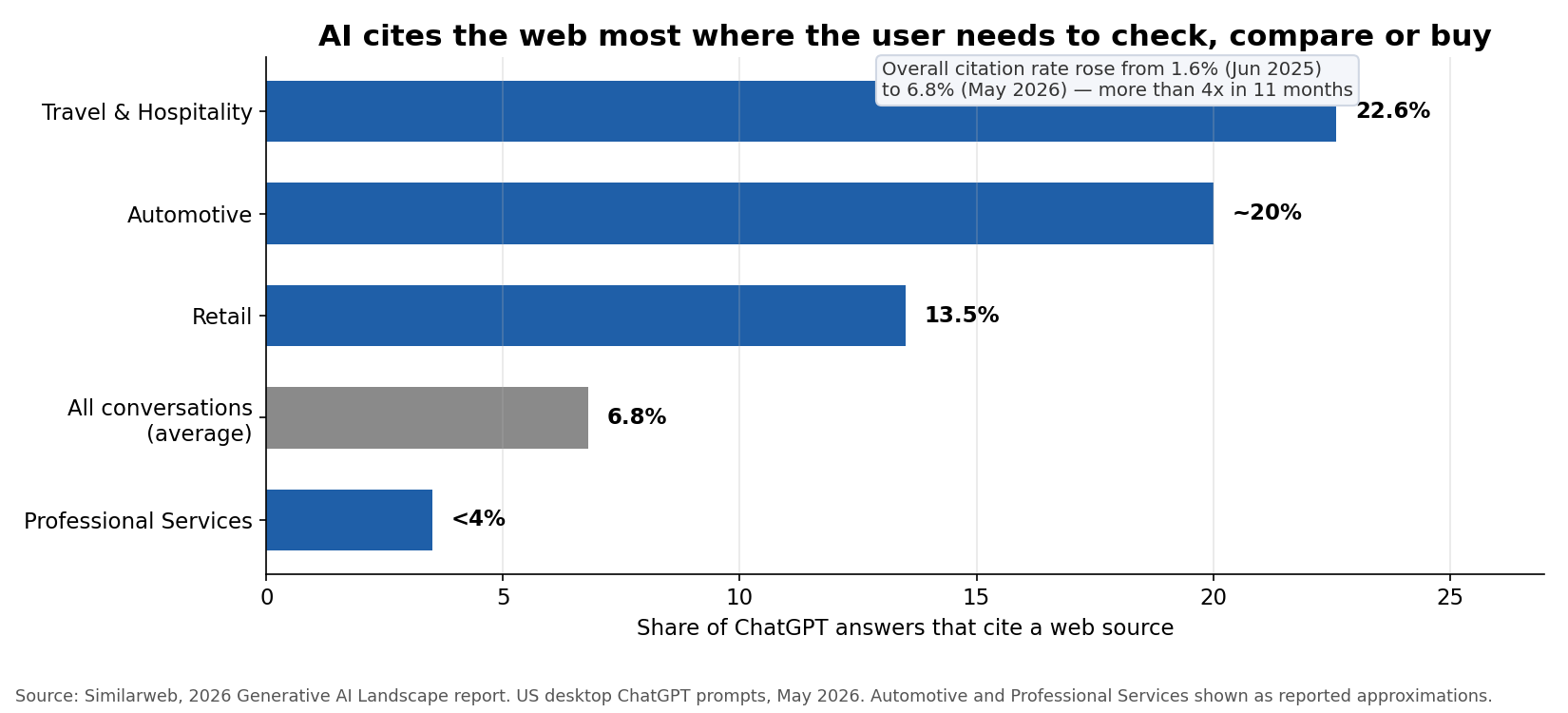
Travel and automotive answers cite the web four to six times more often than professional-services answers. The AI sends people somewhere when a generic answer isn’t enough, and that pattern runs through every industry below.
Part 6: Industry by industry, the story changes completely
There is no such thing as “SEO” as one homogeneous channel. Ahrefs’ benchmark of 344,956 real Search Console properties shows how differently organic traffic is distributed even before AI is factored in.
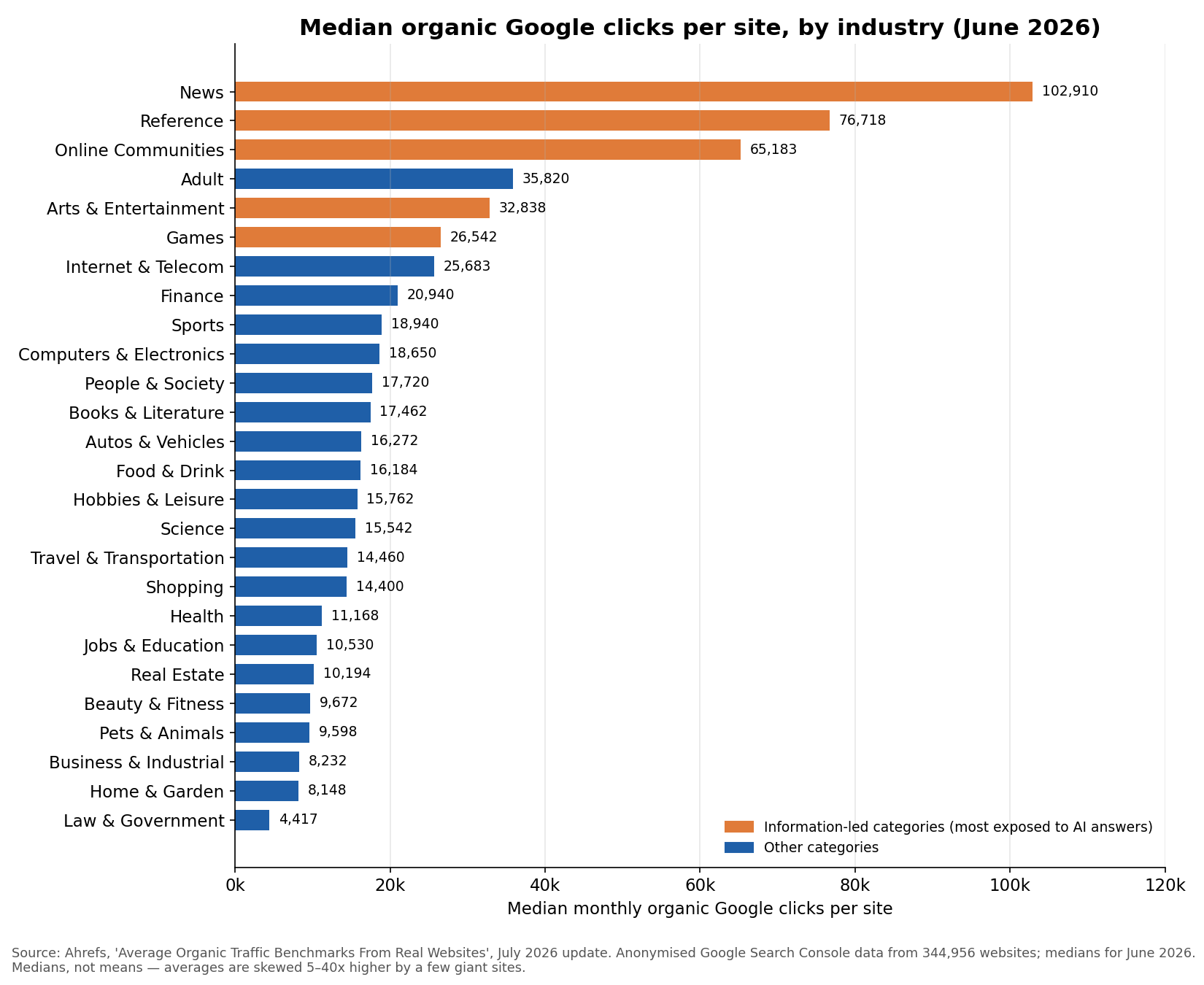
The categories at the top of that chart are the ones most exposed to AI answers. The categories at the bottom are the ones whose clicks are hardest to replace.
Publishing and media: the danger zone
A publisher monetises search → click → pageview → ad or subscription. AI intercepts that at the click. Pew’s data makes the threat concrete, and the median news site still earning over 100,000 organic clicks a month tells you how much is at stake.
But note what the problem is and isn’t. People have not stopped wanting news or reference information. The information layer has simply become cheaper to consume without visiting the source. Similarweb shows news sites receiving 44.5 million AI referral visits a month, and ChatGPT’s link change lifted that further. The traffic exists; the terms of trade have changed. Publishers with original reporting, proprietary data or a subscription relationship have leverage in that negotiation. Publishers who rewrote the same wire story have none.
B2B and SaaS: harder, but more valuable
A SaaS company does not need someone to read 2,000 words on “what is customer success.” It needs someone with a problem. The valuable queries look like alternatives to Salesforce, SOC 2 compliance software, customer support tool for Shopify stores: short, commercial, constraint-laden queries that rarely trigger an AI Overview and are hard to answer with a generic summary because the user is weighing trade-offs.
Search has unusually high strategic value when the query expresses a business problem.
Ecommerce: Google isn’t the only battlefield
Product discovery now spans Google, Amazon, TikTok, Reddit, YouTube and, increasingly, a chat window. Similarweb finds AI assistants structurally favour large multi-category marketplaces when answering “where can I buy X,” which is why marketplaces lead AI referrals and beauty conversations cite retail domains 55% of the time.
So ecommerce SEO has two layers now: your own domain, and your presence on the platforms AI already prefers to link. Google itself remains an intent engine; someone typing “best air purifier for Bangalore apartment” has done more qualification than anyone scrolling Instagram.
Travel: discovery survives because the transaction survives
“Plan me five days in Japan” replaces dozens of informational searches. But eventually the user must book a flight, compare hotels, check availability and read reviews. Travel is the most-cited category in ChatGPT for exactly this reason. AI is strongest when the need is tell me; search and websites take over when it becomes help me decide and let me do it.
Finance and healthcare: trust becomes the moat
Where the cost of a bad answer is high, AI makes generic explanations cheaper and authoritative sources more valuable. Pew found government sites were three times as common in AI summaries as in standard results. If ten websites repeat the same information, AI makes them interchangeable. If one organisation owns the underlying data, research or credentials, it becomes disproportionately valuable. Entity authority and provenance are the new backlinks.
Local services: search is extremely hard to kill
“Emergency plumber near me.” “Dentist near me.” The user eventually has to go somewhere or call someone. AI can improve discovery, but it cannot eliminate geography. The interface may become Maps, an assistant, or a voice prompt in a car, but the job is unchanged: find me something that satisfies this need. That is search.
The pattern
The closer a query sits to an economic transaction, the harder it is for an answer alone to replace the underlying business. AI can explain why you should buy a mattress; it cannot manufacture one. It can summarise mortgage options; it cannot underwrite the loan.
Part 7: What this means for how we work
The real battle is not SEO vs AI
The strategic question is: who owns the user’s decision? If Google answers without a click, Google owns the answer. If ChatGPT names five vendors, ChatGPT shapes consideration. If Reddit says which vendor people actually trust, Reddit owns validation. If the user then searches your name and lands on your site, you own the transaction.
A modern buyer might see a product on TikTok, search Google for reviews, read Reddit, ask an assistant to compare alternatives, search the brand, visit the site, watch a YouTube review, return via a branded search and buy. Which channel gets credit? If your analytics says “organic” at step eight, did SEO create that customer? No. Did it contribute? Almost certainly. Last-click attribution was always a convenient fiction; it is now an actively misleading one.
The metric to stop obsessing over
Organic sessions. I would rather have 10,000 commercial visitors than 500,000 informational ones who never buy, and rather be cited in 100,000 AI answers than earn 100,000 clicks on content unrelated to my business. The measurement stack should look more like this:
| Metric | What it tells you |
|---|---|
| Non-brand commercial impressions | Demand capture |
| Conversion rate by query intent | Traffic quality |
| Organic pipeline and organic CAC | Revenue and efficiency |
| Branded search growth | Demand creation, including AI-driven |
| AI citation frequency and share of model | Answer-engine visibility |
| Homepage and “direct” traffic trend | Hidden AI influence |
| AI-assisted conversions | Influence, not just referral |
The five layers of modern search optimisation
- Technical discoverability. Can machines understand your site? Still boring, still necessary, and now it includes AI crawlers.
- Demand capture. Can you appear when someone expresses a problem you solve? Classic SEO. Not going anywhere.
- Authority. Does the ecosystem recognise you as a credible source? Increasingly the gate for both traditional search and AI citation.
- Entity and brand visibility. Does the internet understand what your company is and why it matters? Essential as search becomes semantic and conversational.
- AI visibility. When someone asks an assistant a question in your category, are you mentioned, and why? Being cited as a source is not the same as being recommended as a solution.
The pitch has to change
If your agency’s pitch in 2026 is “we’ll get you to number one for 50 keywords,” I don’t know what to tell you. The SERP is too complicated, the interface is changing too fast, and ranking position alone no longer describes visibility. The pitch should be “we will increase your share of qualified discovery across the search and answer ecosystem.” Harder problem; more valuable one.
So, is SEO dead?
No. But a lot of SEO is dead.
Under serious pressure: generic informational content, commodity listicles, thin affiliate pages, programmatic content without unique value, AI-generated summaries masquerading as expertise, and any business model that depends on informational pageviews.
Becoming more valuable: original research, proprietary data, first-hand experience, product-led content, high-intent commercial pages, local and product discovery, communities, strong brands, and anything an AI cannot simply synthesise.
The old question was how do I rank? The new one is how do I become the answer? You cannot manufacture authority with a keyword list, fake proprietary data, or build a brand with 200 pieces of slop. Search used to reward the best optimisation. Increasingly it rewards the most useful entity in the ecosystem, which is a harder game and a far more interesting one.
Underneath all of this, the human behaviour has not changed. People still have questions, problems and purchases to research. They still look for restaurants, doctors, software, jobs and financial products. What is changing is the interface, the sources they trust, the economics of the click and the measurement. That is not the same as search dying. If anything, we are at the beginning.
Data notes and sources
This article deliberately mixes several kinds of evidence with different populations, units and time windows. They should not be read as one continuous dataset, and no single number here proves “SEO grew X% a year.” The strongest claim the data supports is that search remains an enormous source of intent and economic value while the mechanism that turns intent into a click, citation, recommendation or conversion is changing.
Alphabet / Google. Advertising revenue by year from Alphabet’s 10-K filings; 2025 Google advertising revenue $294.7B, Search & other $224.5B, paid clicks +6%. Q2 2026 results (July 22, 2026): Search & other +17% to $63.3B; Pichai’s World Cup remark from the earnings call. Used as a proxy for the economic scale of the search ecosystem, not for organic traffic. - Alphabet 2025 Form 10-K - Alphabet Q2 2026 results
Pew Research Center. Browsing data from 900 US adults, 68,879 Google searches, March 2025. 8% vs 15% traditional-result clicks; 1% clicks on links within summaries; 26% vs 16% session ends; AI-summary trigger rates by query length and type. Google disputed the query mix. - Google users are less likely to click on links when an AI summary appears
Similarweb, 2026 Generative AI Landscape report (published July–September 2026). 770.7M average monthly AI referral visits (Jun 2025–May 2026, +117.4%); industry volume and growth; ChatGPT–Google user overlap flat at 95%; platform share shift; citation rates (1.6% → 6.8%; Travel 22.6%, Retail 13.5%); ChatGPT’s May 7, 2026 link change; homepage-referral share; AI Overviews on 40%+ of US searches; 2.5x branded-visit lift. - AI Search Stats 2026 - AI Referral Traffic by Industry - Is AI Replacing Search?
Ahrefs. Median monthly organic Google clicks by industry from anonymised Search Console data on 344,956 sites, June 2026 (July 2026 update). Whole-site organic CTR benchmarks from the companion study. AI Overview click-reduction figure from Ahrefs’ 2025 update. - Average Organic Traffic Benchmarks From Real Websites - What is a Good Organic CTR?
Adobe Digital Insights. AI-sourced traffic to US retail sites converting 54% better than non-AI sources by May 2026 (via Similarweb and Adobe’s blog).
Search market share. Google’s share of global search is commonly reported at roughly 90% (StatCounter, 2026). Treated as approximate.
Charts. All charts in this article were rebuilt from the figures above. Where a source published only a range or approximation, the chart notes say so. The prior-year AI referral figure (~355M) is derived from Similarweb’s reported +117.4% growth, not stated directly.